Understanding differences in Ohio reservoir Largemouth Bass populations
Overview
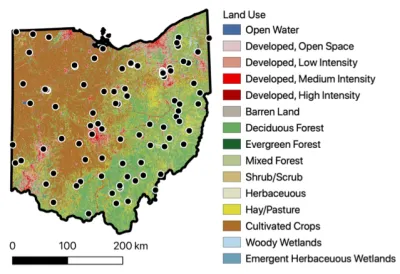
The creation of reservoirs for recreation, water supply, and flood control has resulted in a set of spatially distinct lake habitats set across Ohio’s landscape (Figure 1). Understanding of how fish populations in these patches respond is often limited to the individual habitat patch (i.e. the reservoir), rather than the larger landscape of patches. Isolation and limited migration among these patches may set up conditions for population differentiation (e.g., in life history traits), either as a result of adaptations to local environmental conditions or plastic responses to local environmental conditions, or as a reflection of source stocks used to populate the patches.
Previous research has focused on species occurring across a landscape of natural lakes (e.g., Minnesota), where the spatial structure has often existed since the last glacial retreat (9000-14,000 years ago), resulting in genetically distinct populations with different life history patterns. Far less research has focused on genetic and life history structure across the similar, but more recently created, lake landscapes of the Midwestern reservoirs. These human-created landscapes are much younger, having been created and stocked in the last 30 to 100 years.
Our primary objective is to understand how Largemouth Bass (Micropterus salmoides) populations differ across the landscape of Ohio reservoirs, what environmental characteristics are influencing this variation, and what mechanisms underlie this variation. Little is known about Largemouth Bass population relatedness throughout Ohio despite the potential for connection or isolation among sub-populations and the potential for intrusion by genes from fish brought into the state from other sources. Understanding if and how environmental differences are influencing the life history strategies and genetic landscape of these populations will provide information on how fish populations are impacted by human-created habitats, aiding in lake specific conservation and management decisions.
Objectives and Methodology
1) Documenting and Explaining Spatial Patterns among Largemouth Bass Populations
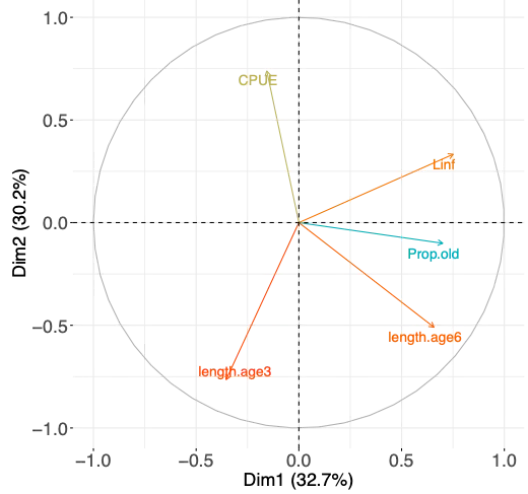
Using the Ohio Fisheries Information System, a large historical database on Ohio reservoir and fish populations, we described spatial patterns in Largemouth Bass life history characteristics. Because some important population and life history traits are difficult to measure directly (e.g., longevity, population size), we used proxies to approximate the responses of interest. We characterized reservoirs by spatial patterns in catch-per-effort (an index of population density), proportion of “old” fish in the population (a proxy for longevity), length at age 3 (an indication of early-life growth), length at age 6 (an indication of later-life size), and L∞ (an estimate of asymptotic length, assuming a commonly used function of fish size with age). We identified correlated suites of these life history traits using Principle Component Analysis.
Using these suites of life history traits, we tested whether variation among reservoirs can explain any observed variation among populations. We performed linear models to determine which reservoir characteristics are important predictors of these life history patterns. As with the life history traits, some reservoir characteristics are difficult to measure directly, so we used proxies. We characterized reservoirs by development of shoreline (a proxy for habitat availability), the proportion of watershed area to surface area (a proxy for flashiness of flow), angler success (a measure of angler pressure), water temperature, and proportion of agriculture in the watershed (proxies for growth environment).
2) Genetic Structure among Populations
In addition to quantifying phenotypic variation among populations, we will determine genetic variation. Ohio reservoirs – and thus the populations within them - are young in comparison to most natural lakes (average Ohio reservoir age 60-65, range 30 to over 100 years); however, evidence of rapid evolution in other systems (Heath et al., 2003; Pasley et al., 2014; Brans et al., 2017) suggests that these populations may have diverged genetically even in such a short period. Using fin clips collected from Largemouth Bass populations across Ohio, we will determine genetic structure among populations, testing for the influence of geography, environmental conditions, and known stocking history.
3) Using Effective Populations Size to Understand Recruitment Limitations
Understanding factors limiting juvenile survival will allow for reservoir specific management decisions to optimize the fishery. We will relate the variation in Largemouth Bass population density (measured via CPUE in Objective 1) to the number of individuals contributing genetic material to the population (i.e. effective population size). This comparison will inform how many individuals are surviving to reproductive age (i.e. recruitment) and discern what factors (e.g., prezygotic or postzygotic) are limiting this recruitment. For example, low population density compared to low effective population size suggest pre-zygotic factors (e.g., spawning habitat, environmental conditions, sex ratios, phenology) and low population density compared to high effective population size suggests postzygotic factors (e.g., prey limitation, predation, water-level fluctuations). We will use the genotype information collected during Objective 2 to estimate effective population size via the linkage disequilibrium and temporal methods.
4) Experimentally Distinguish between Plasticity and Genetic Sources of Population Variation
While the previous objectives will provide information about the phenotypic and genetic variation among Ohio reservoir Largemouth Bass populations, we will also experimentally determine the underlying mechanism of the observed patterns. We will perform a set of common garden experiments using Largemouth Bass sourced from populations with distinct life history strategies and reservoir characteristics to determine what extent phenotypic plasticity and genetic differences contribute to observed variation.
Key Findings
1) Documenting and Explaining Spatial Patterns among Largemouth Bass Populations
- We identified two suites of life history traits, 1) the inverse relationship between length at age 3 (early life growth) and CPUE (population density), and 2) the positive relationship between length at age 6 (later life size), proportion of old fish (longevity), and L∞ (Figure 2).